
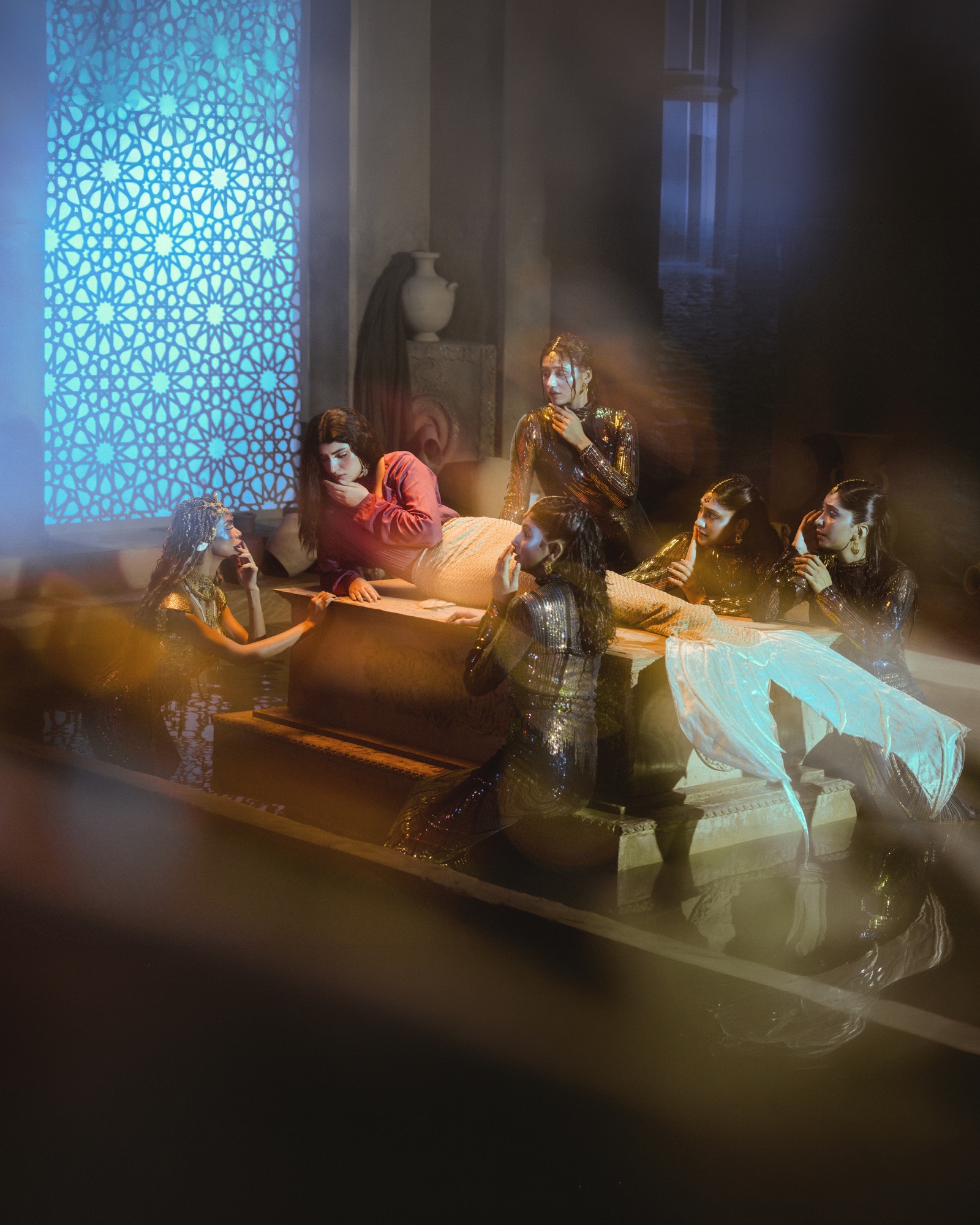
There are stories that belong to history, and then there are stories born from the fragments history leaves behind. A river. A forgotten legend. A creature glimpsed somewhere between imagination and memory. In Fahad Hussayn’s world, these fragments have always carried the possibility of becoming something larger.
With Gul Raavi, his latest menswear campaign explored through his audio-visual experience, that possibility becomes an entire universe.
Inspired by the mythical mermaids of the River Ravi, the episodic series travels into a fictional Punjab inhabited by Gul, Prince Raavi, Zakhiya and a kingdom concealed beneath the waters. Here, folklore finds a contemporary voice through cinema, music and fashion, while Fahad’s signature menswear becomes part of the mythology itself.
Visually, the campaign slips between submerged palaces, dimly lit chambers, bathing courts, patterned screens and sandstone arches washed in amber light. Water follows the story almost everywhere, glowing turquoise in one frame and turning almost black in another. Around it gather men, royals and fantastical beings dressed as though they belong to a civilization remembered only in fragments. Against this world, the menswear appears almost ceremonial. Ivory sherwanis glow against warm stone. Mint and emerald drapes echo the water. Black arrives with gold and carries the authority of a courtly uniform.
So, what makes Gul Raavi one of Fahad Hussayn’s most fascinating experiments with fashion and storytelling yet? We dive into the depths…
A Folklore Rises From the Ravi
Punjab has always carried its stories through the spoken word. Tales have travelled across generations through qissas, songs, rivers and memories, acquiring new details each time somebody chose to tell them again. With Gul Raavi, Fahad enters that tradition and imagines another legend for the landscape.
The River Ravi becomes his starting point. Its mythology of mermaids provides the seed from which an original fairytale grows, populated by Gul, Prince Raavi, Zakhiya and an entire kingdom beneath its waters. Each episode expands that mythology, revealing another character, another conflict and another piece of the collection along the way.
The campaign imagery strengthens that imagined geography. In one sequence, a golden aquatic figure appears crowned and sculptural, almost like a deity preserved beneath the river. Elsewhere, men gather around luminous pools in spaces that resemble royal hammams, their bodies and draped garments illuminated by fire and coloured light. Another frame reveals characters standing beneath soaring arches as water cuts through the architecture like a living vein.
There is something particularly intriguing about creating folklore in the present. Heritage here becomes a living imagination, capable of evolving beyond archives and museums. Fahad takes the cultural memory surrounding a river and allows fiction to carry it forward.
Even the colour story seems to emerge from the Ravi itself. Moss greens, mint, deep emerald and teal move through the menswear, while ivory suggests moonlight over water and black carries the weight of the river at night. Gold appears like treasure recovered from beneath the surface.
Somewhere between the water and the wardrobe, Gul Raavi begins to feel like a qissa waiting to be inherited.
A Campaign Becomes a Kingdom
For years, fashion advertising has revolved around a familiar question: how does one photograph the clothes? Gul Raavibegins somewhere far more expansive. It asks what kind of world could possibly contain them.
That shift changes everything.
Across its episodic format, fashion becomes cinema, advertising becomes entertainment and the collection acquires meaning through the characters who inhabit it. Audiences enter through Gul and Prince Raavi, follow the tensions surrounding Zakhiya and discover the garments as the mythology grows around them. Each reveal consequently carries the residue of the story that came before it.
The environment does an enormous amount of that storytelling. Dark corridors open onto pools. Giant wooden doors stand beside lanterns and almost black water. Blue light pours through elaborate geometric screens. Other spaces glow with terracotta, ochre and faded frescoes, creating the feeling of a palace built from several centuries of South Asian visual memory.
Then the episodic imagery shifts into the collection portraits, and the same visual language remains. Models stand beside carved arches, water channels and painted columns while dressed in mint, ivory, green and embellished neutrals. The garments therefore feel as though they have stepped directly out of the fictional kingdom and entered the fashion frame.
View this post on Instagram
It also places Fahad in familiar creative territory. His approach has long treated fashion as a meeting point for image, music, performance and narrative. Gul Raavi stretches that philosophy further through screenwriting, direction, costume, production design and sound, all functioning as pieces of one elaborate puzzle.
The result feels remarkably close to intellectual property built through fashion. The clothes have a season. The world surrounding them possesses the potential for a much longer life.
Heritage Finds Another Way Home
Perhaps the most compelling aspect of Gul Raavi lies in its relationship with heritage. Fahad approaches Punjab through its imagination, looking towards the stories a culture invents about itself and the landscapes that inspire them.
The Ravi consequently carries far more than water through this universe. It holds fantasy, romance, danger and the remnants of oral traditions that gradually disappear when generations stop retelling them. By drawing upon the mermaid mythology surrounding the river and transforming it into original fiction, Gul Raavi gives those cultural impulses another form in which to survive.
View this post on Instagram
The visual references make that relationship especially rich. The architecture carries pointed arches, jharokha inspired openings, ornate latticework, aged frescoes and cavernous interiors. The interiors feel historical in spirit while remaining fantastical in construction. A submerged kingdom therefore becomes believable because its design language already feels culturally familiar.
That distinction gives the project its strength. Fiction gives Fahad the freedom to let Punjab dream again.
The collection follows a similar philosophy. Its silhouettes draw from ceremonial South Asian menswear while feeling contemporary in proportion and styling. Long sherwanis are worn with flowing trousers. Shawls are draped expansively over the body. Structured jackets appear beside softer kurtas. Decorative surfaces evoke historical ornament without turning the garments into replicas of any singular period.
Even the campaign’s water seems to hold memory. Sometimes it appears turquoise and inviting. At other moments it becomes dark and reflective, catching only firelight and shadow. The river therefore functions almost like another character, shifting its mood as the mythology grows.
There is a tenderness to that idea. Rivers remember civilizations long after cities change around them. Here, the Ravi remembers through fantasy. Its waters grow kingdoms, its legends acquire faces and its cultural memory finds its way onto film and fabric.
Menswear Becomes Part of the Myth
And then, of course, come the clothes.
Fahad Hussayn’s iconic black menswear returns with the authority it has carried through his design vocabulary for years. Contemporary sherwanis, statement shawls and elevated festive silhouettes inhabit Gul Raavi with an almost ceremonial quality. Within the fictional kingdom, they begin to read as extensions of character, giving Prince Raavi and the men surrounding this mythology their own visual language.
One of the strongest looks arrives in black and gold. The long silhouette is richly worked across the surface, with embroidery gathering around the neckline, body and border. Paired with a dark shawl, it carries the confidence of a ceremonial robe while remaining firmly within Fahad’s contemporary menswear vocabulary.
Ivory provides another recurring thread. White and cream kurtas and sherwanis are treated with measured gold embellishment, sometimes concentrated around the collar and chest, sometimes travelling through shawl borders. Against the campaign’s ochre arches and terracotta interiors, the ivory looks almost luminous.
The greens, however, belong completely to Gul Raavi.
A mint ensemble combines a fitted upper silhouette with relaxed trousers and an elaborately bordered shawl that falls almost to the floor. Another look uses deeper emerald with richly ornamented draping, giving the wearer the presence of someone who belongs naturally to the fictional river court. Even the lighter sage tones feel connected to water, moss and the submerged architecture of the narrative.
The surface development brings another layer of interest. Handcrafted embroideries sit upon industrially designed surfaces, bringing artisan skill into conversation with engineered precision. Traditional techniques consequently acquire a contemporary architecture, while the richness associated with ceremonial menswear feels sharper and more current.
There is softness too. Fahad’s embroidered chiffon kurtas return ahead of the festive season, bringing lightweight luxury into the collection and revisiting one of his recognisable menswear signatures. Black chiffon appears dense with subtle surface work and a heavily defined neckline. Emerald brings depth through tone. Peach introduces warmth, while white allows light to reveal the intricacy of the textile itself.
View this post on Instagram
The shawls deserve their own attention. Some remain tonal and restrained, while others are heavily patterned and bordered, creating movement around otherwise structured silhouettes. Their scale lends the men an almost princely grandeur, especially within the campaign’s expansive architecture.
Through Gul Raavi, these elements become costume, character and craft simultaneously. The embroidery carries technique. The silhouettes carry identity. The colours carry the river. Together, they dress a legend into existence.
Fashion Advertising Finds Its Next Story
Gul Raavi ultimately raises an interesting question about where Pakistani fashion communication can travel from here. In a global luxury landscape where cinema, narrative and cultural mythology increasingly surround the product, Fahad offers an interpretation rooted firmly within South Asian imagination.
The ambition lies in the scale of the thought. A seasonal menswear collection becomes the foundation for characters, kingdoms, conflict, music and episodic storytelling. Each creative discipline feeds the next. Fashion provides the visual identity. Cinema gives it movement. Music gives it atmosphere. Fiction gives the audience a reason to return.
And the campaign imagery makes that marriage between product and mythology particularly convincing. The formal studio portraits allow every embroidered collar, engineered surface and draped shawl to be examined in clarity. Then the cinematic episodes return those garments to their imagined homeland, placing them beside water, fire, carved stone and fantastical characters.
The clothes therefore receive two lives.
One exists in the precision of fashion. The other exists in the mythology of Gul Raavi.
Perhaps that is where the project finds its greatest power. It treats cultural imagination as something capable of producing new legends while allowing clothing to become one of the ways those legends acquire form. Fahad has built a world where the Ravi can carry mermaids again, where menswear can belong to princes, and where a campaign can grow into mythology.
It also suggests an intriguing future for luxury advertising in Pakistan. Garments can command attention through craftsmanship, but stories give audiences a reason to remain. Characters can return. Kingdoms can expand. Songs can acquire context. A shawl, sherwani or embroidered kurta can become associated with a fictional memory larger than the product itself.
The collection will eventually belong to a season.
Gul Raavi feels ready to keep flowing.